
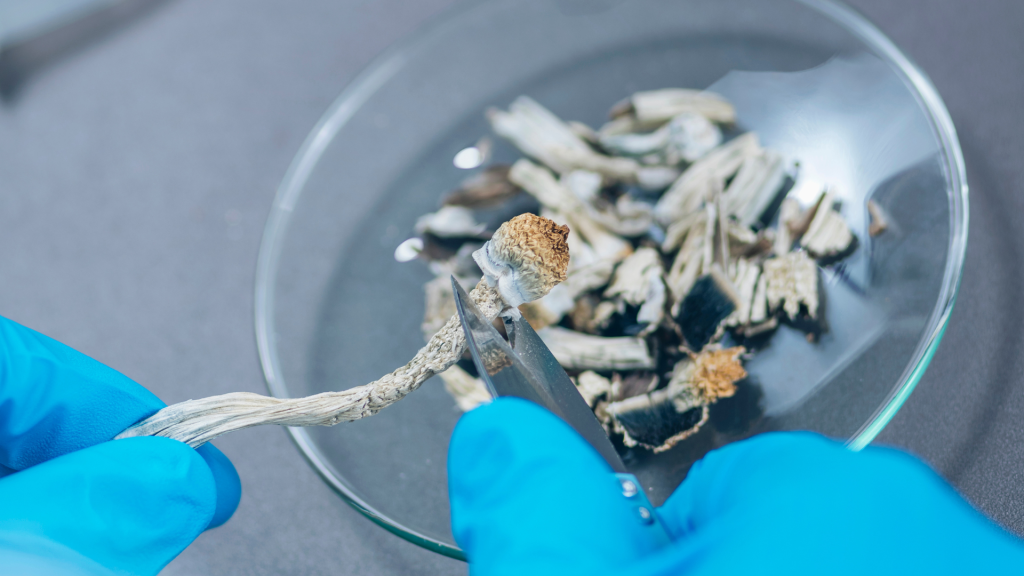
If you’ve ever gone foraging and thought you’d spotted a magic mushroom, you probably felt that mix of excitement and hesitation. It’s tempting to think you can just spot them by the color or the shape, but the truth is, nature doesn’t make it that easy. There are hundreds of mushrooms that look like Psilocybe species, and some of them can make you very sick.
Learning how to identify magic mushrooms isn’t just about curiosity, it’s about safety, respect, and understanding the living network they come from.
What Makes a Magic Mushroom “Magic”?
Magic mushrooms are species that contain psilocybin and psilocin, the natural compounds responsible for their psychedelic effects. Most belong to the Psilocybe genus, though other genera like Panaeolus, Pluteus, and Gymnopilus can contain similar chemicals.
“Not every small brown mushroom is a magic mushroom, some are just small brown mushrooms.”
That’s why experienced foragers rely on more than color or size, they look at specific features: the cap, gills, stem, spore print, and even the habitat where it grows.
Key Identification Features
According to Paul Stamets’ Psilocybin Mushrooms of the World, the most reliable way to identify a psilocybin mushroom is to look for a blue bruise reaction. When the stem or cap is handled, it often turns a bluish color due to oxidation of psilocin.
Still, that alone isn’t enough. True Psilocybe mushrooms share several traits:
- Cap shape: Usually conical or bell-shaped, sometimes with a small central bump.
- Gills: Dark brown to purple-black as they mature, with close spacing.
- Spore print: Always dark purple-brown, one of the best ways to confirm identity.
- Stem: Thin and fibrous, often hollow, and bruises blue when touched.
- Habitat: Found on decaying wood, grassy pastures, or dung-enriched soil depending on the species.
“When in doubt, make a spore print. A single shade of brown can mean the difference between mystical and medical emergency.”
Common Species and Their Look-Alikes
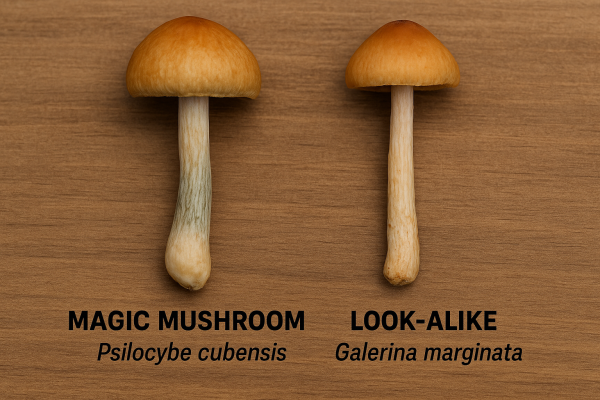
1. Psilocybe cubensis – The most common species. Has a golden-brown cap and grows on manure-rich soil in tropical regions.
-
- Look-alikes: Galerina marginata (deadly), Conocybe filaris (toxic).
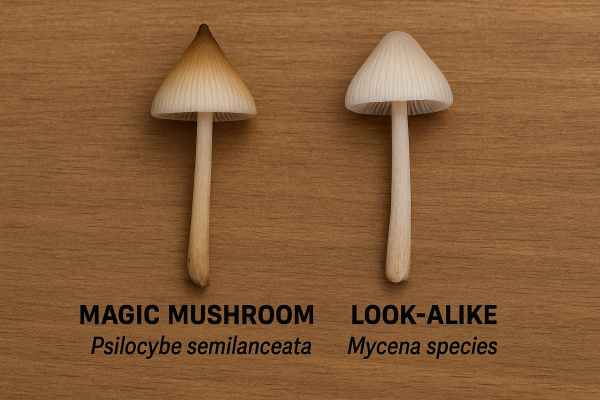
2. Psilocybe semilanceata (Liberty Cap) – Found in grassy fields and meadows, with a pointed tip on its cap.
-
- Look-alikes: Mycena species and other grass-loving mushrooms that lack blue bruising and have white spore prints.
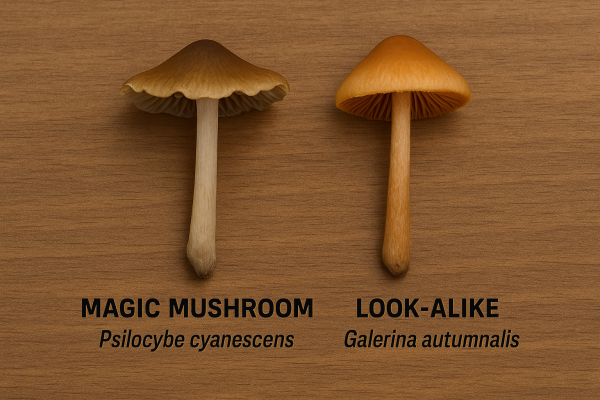
3. Psilocybe cyanescens (Wavy Cap) – Known for its wavy edges and strong potency; grows on wood chips and garden mulch.
-
- Look-alikes: Galerina autumnalis (deadly toxic), which looks similar but has rusty orange spores.
A 2022 Frontiers in Forests and Global Change study emphasized how similar many toxic and psychedelic mushrooms look, even to trained mycologists. That’s why experienced foragers always double-check spore prints, habitat, and the bluing reaction before making any assumptions.
Why Identification Is So Tricky
Mushrooms change appearance as they age. Young Psilocybe cubensis can look nothing like mature ones. Weather also alters color and shape. Even experts use microscopes to check spore details or, more recently, DNA barcoding, which has revealed that many “known” specimens were misidentified.
A 2022 study in the Journal of Applied and Environmental Microbiology found that even cultivated mushrooms sold under the same name sometimes contained different chemical profiles. That means visual ID isn’t enough if safety matters.
“Mother Nature loves disguises, especially in the mushroom kingdom.”
Spore Prints: Your Best Friend
Making a spore print is one of the safest identification tools. To do it:
- Cut the cap and place it gill-side down on white paper.
- Cover it with a glass bowl.
- Wait several hours.
Psilocybin-containing mushrooms leave a dark purple-brown print. If the print is rust-colored or orange, it’s likely toxic.
A Note on Safety
Never eat a mushroom unless you are absolutely certain of its identity. Some poisonous species can destroy the liver or kidneys even in tiny amounts. The deadly Galerina genus, for example, looks nearly identical to Psilocybe cyanescens.
If you’re learning, connect with local mycology clubs or field guides by experts like Paul Stamets. Apps and photos are helpful, but they’re not foolproof.
“When you’re unsure, assume the mushroom’s answer is no.”
Summary
Identifying magic mushrooms takes practice, patience, and respect for detail. Key signs include blue bruising, purple-brown spore prints, and habitat clues. But because toxic look-alikes exist, visual ID alone is never enough. True identification combines field observation with chemical or DNA confirmation, because safety always comes before curiosity.
Sources
Stamets, P. – 1996 – Psilocybin Mushrooms of the World: An Identification Guide
Strauss, D. et al. – 2022 – An Overview on the Taxonomy, Phylogenetics and Ecology of the Psychedelic Genera Psilocybe, Panaeolus, Pluteus and Gymnopilus
J. Bradshaw et. al. – 2022 – DNA Authentication and Chemical Analysis of Psilocybe Mushrooms Reveal Mislabeling and Identification Challenges