
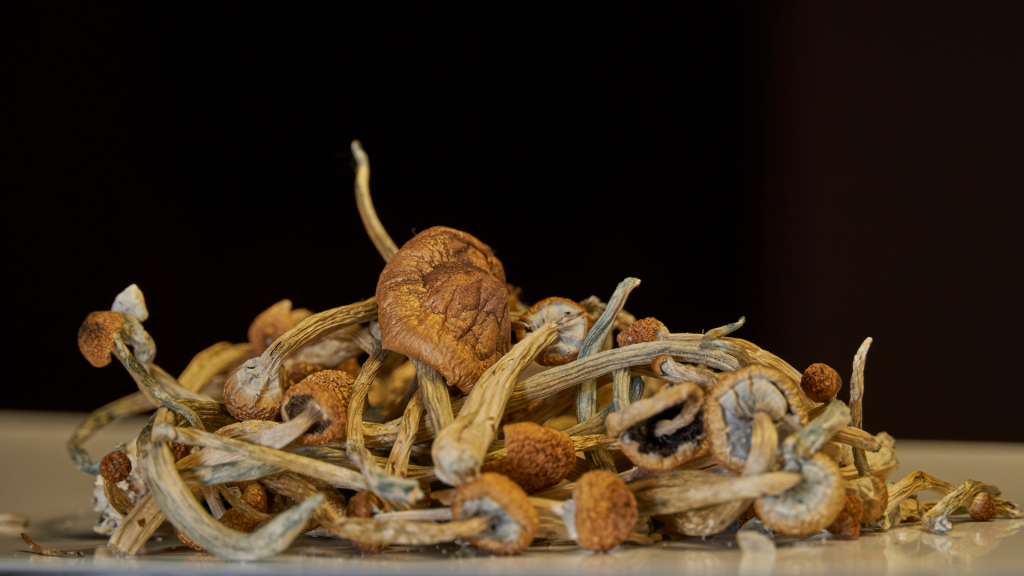
Most people know mushrooms (available with Offerings) are earthy and tasty, but not everyone knows mushroom nutrition facts. And even though magic mushrooms aren’t eaten for nutrition, they share a similar structure to regular edible mushrooms. So the basic nutritional profile gives us a good idea of what’s inside them too. When you zoom out and look at the research, mushrooms turn out to be surprisingly rich in vitamins, minerals, antioxidants, and fiber, way more than people expect from something so light.
What Regular Mushrooms Contain (And What That Means for Magic Ones)
Since magic mushrooms aren’t commercially farmed or included in official nutrition databases, the best way to understand their nutritional makeup is to look at their closest cousins: white button mushrooms, portobellos, creminis, and other common edible varieties. These mushrooms have a similar cell structure, water content, and nutrient matrix, so the comparison holds up pretty well.
According to MyFoodData, a full cup of raw mushrooms is low in calories but packed with nutrients. They’re “nutrient-dense despite being extremely low in fat,” which is exactly what you’d expect from dry magic mushrooms too.
MDPI’s review backs this up, calling mushrooms “nutritional powerhouses” because they contain antioxidants, proteins, B-vitamins, and minerals found in far heavier foods.
ScienceDirect puts it simply: mushrooms offer “a unique combination of micronutrients, bioactive compounds, and dietary fiber.”
Magic mushrooms work the same way, small, dry, low-calorie, and rich in compounds the body recognizes easily.
Key Nutrients Found in Mushrooms
Here’s what makes mushrooms surprisingly valuable from a nutrition standpoint:
B Vitamins
Edible mushrooms contain B2, B3, B5, and B9, which help with energy, brain function, and metabolism. Magic mushrooms grow the same way and contain the same cellular building blocks, so they share this vitamin profile.
Minerals
Research shows mushrooms contain copper, potassium, selenium, and iron in meaningful amounts. Magic mushrooms carry similar trace minerals because they grow in mineral-rich environments (soil, manure, wood substrates).
Protein
Mushrooms are low in total protein but offer all essential amino acids. ScienceDirect mentions mushrooms as “a valuable protein source relative to calorie content.” Magic mushrooms have the same fungal protein matrix, small but complete.
Fiber
Both edible and magic mushrooms are rich in chitin, a type of fiber the body doesn’t digest. MDPI points out that chitin supports gut health by acting like roughage. This is why mushrooms sometimes cause slight stomach reactions, your gut is working to break down the tough cell walls.
Antioxidants
Mushrooms contain ergothioneine and glutathione, two powerful antioxidants. MDPI highlights these as major contributors to cell protection. Magic mushrooms appear to carry the same antioxidants because they share similar biological pathways.
Magic Mushrooms: Nutrients vs. Effects
Even though magic mushrooms do contain nutrients, here’s the honest truth:
People don’t take magic mushrooms for nutrition, and the amounts eaten are too small to matter for dietary value.
A typical dose is 1–3 grams, that’s basically a pinch of dried mushroom. Nutritionally, it’s almost nothing.
But the underlying nutrient profile helps explain things like:
- why some people feel slight stomach reactions
• why they’re extremely low-calorie
• why they dry out so quickly
• why they behave like edible mushrooms in the body
It’s not the nutrients that give magic mushrooms their effects, it’s the psilocybin. But the nutritional structure still mirrors regular mushrooms closely.
Beginner-Friendly Takeaway
If you eat a typical magic mushroom dose, you won’t get enough nutrients to change anything about your diet. But you are eating something that’s naturally rich in vitamins, minerals, fiber, and antioxidants, at least on paper. It’s just that the dose is too small for those benefits to matter compared to the psychedelic effects.
Summary
Magic mushrooms share almost the same nutritional makeup as regular edible mushrooms, low calorie, low fat, high in B vitamins, minerals, antioxidants, and fiber. But the doses people take are so small that the nutritional impact is almost zero.
Mushrooms in general are nutrient-dense, packed with vitamins, minerals, proteins, and antioxidants. Magic mushrooms have a similar composition, although people take too little of them for nutrition to matter. Their nutrient profile helps explain their structure and digestion, even though the main focus remains on psilocybin and not vitamins or minerals.
Sources
MyFoodData – Nutrition Facts for Raw Mushrooms
MDPI – Mushrooms as Nutritional Powerhouses
ScienceDirect – A Review of Mushrooms in Human Nutrition and Health